Thinkbox
For most businesses, the cost of advertising is an important consideration, and this is no different when it comes to TV. This section covers how mass (or linear) TV is traded, what impacts the overall price and some other considerations that will influence the cost of TV advertising.
The first and arguably most important thing to note is that, despite popular opinion, TV is not exclusively for the rich and famous or well established ‘big’ advertisers. Advertising on TV need not cost millions of pounds. In 2025, 598 advertisers spent less than £50,000, over 400 spent less than £25,000, and more than 200 spent less than £10,000.
Last year 984 new advertisers appeared on TV - a6% increase YoY - and the commercial TV companies are extremely well placed to help in a variety of different ways:
Not sure how to make a TV advert? The TV companies have specialist creative teams who can advise, assist or produce TV-ready adverts for various levels of investment.
Need help with the process? All of them have specialist teams dedicated to new advertisers, with or without a media agency, and they are more than happy to help guide you through the process.
Concerned about cost? There are a number of ways the commercial TV companies can help to reduce the initial outlay including incentivised pricing, free airtime, shared reward schemes and more.
Speaking directly to one or more of the TV companies can help kick start your TV journey. Contact details can be found here.
How is TV traded?
The currency on which TV is traded is called Cost Per Thousand (CPT). This is the cost of buying 1,000 impacts (note - not the same as reaching 1,000 individuals). These CPTs are variable, constantly changing and are usually represented in the form of a percentage discount off the station average price (SAP). The SAP is a benchmark price against which most buying and selling of TV advertising is calculated.
To learn about how addressable TV is bought, click here.
How do we arrive at the station average price (SAP)?
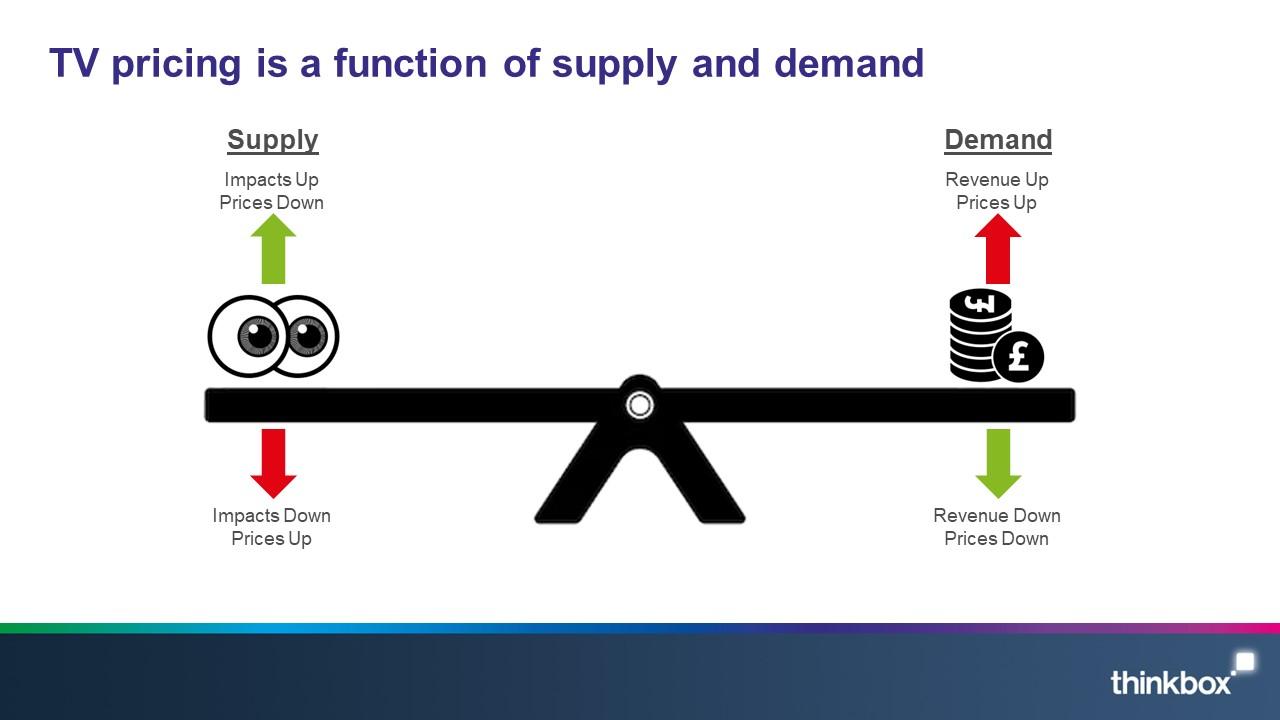
The SAP is a function of supply and demand. The supply in the case of TV advertising is represented by commercial impacts (the number of people watching TV on commercial TV stations) and the demand is represented by advertiser revenue. As you can see from the diagram below, the two sides of the equation work either together or against each other to push prices up or down.
Below are some examples of what can impact supply and demand:
The Economy
In challenging economic times, marketing budgets are often among the first to be reduced, decreasing demand. Simultaneously, consumers with less disposable income may spend more time at home, increasing TV viewership and thus supply.
Audience
Different trading audiences have different SAPs attached to them. Supply and demand influences these prices depending on how much TV they watch and how desirable to advertisers they are.
Programming
Popular shows, like live sports, attract both viewers and advertisers, boosting supply and demand. Conversely, compelling content on non-commercial channels can draw audiences away from commercial TV, reducing supply.
Weather
In warm, sunny weather, audiences spend less time indoors in front of the TV which reduces supply and vice versa.
Regionality
Different UK regions have different SAPs associated to them based on supply and demand. For example, London is the most expensive region due to low supply (longer commutes, longer working hours, etc.) coupled with high advertiser demand based on the relative affluence of the region.
Seasonality
SAPs vary by month based on supply and demand. January is the cheapest (low advertiser spend and high viewing as people stay in post-Christmas) and the most expensive are September to November (heightened pre-Christmas advertising demand outstrips the increased audience supply).
Other cost influencers
Negotiated discount
The final cost of airtime is influenced by the discount negotiated against the Station Average Price (SAP) with the level of discount achieved varying based on factors such as budget, audience, campaign timing and broadcaster commitments.
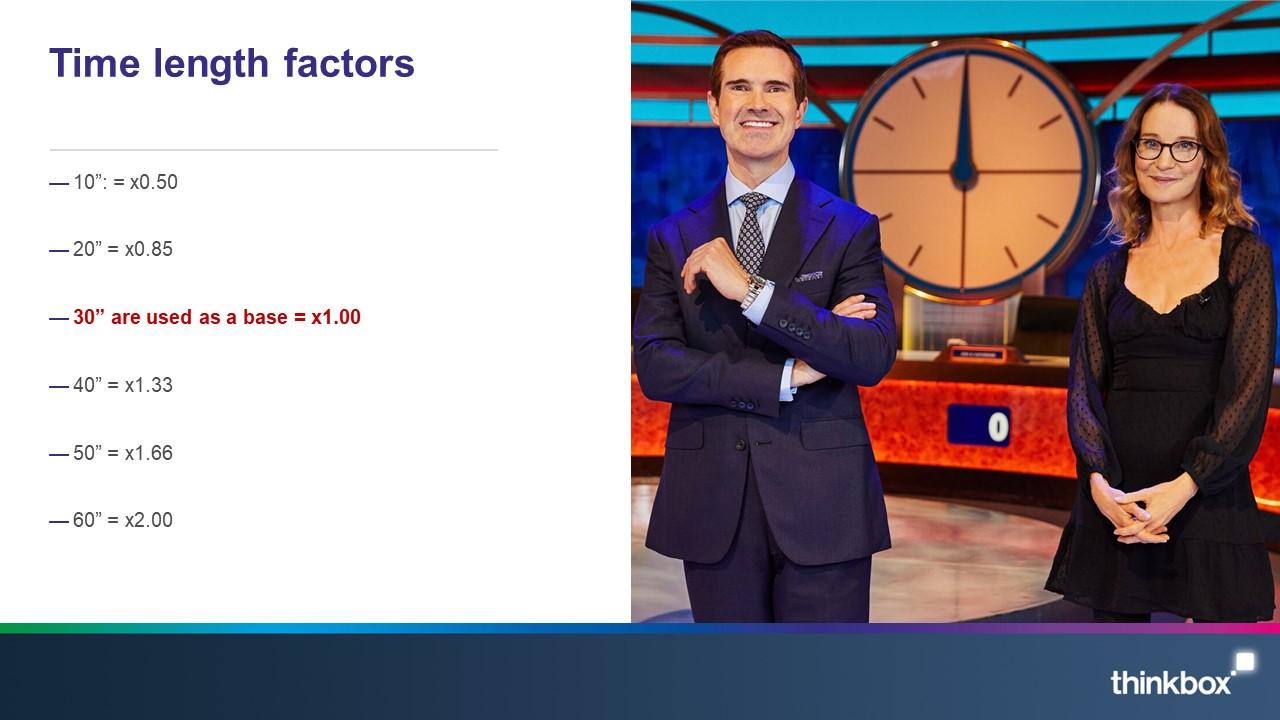
Length of Advert
Costs are based on the copy length, with 30” as the standard unit (time length factor of 1.00). Longer spots are charged proportionally (e.g. 60” = 2.00), while shorter ads carry a slight premium, as shown below.